
Pool Permits in Warners Bay: Your Complete Guide to Lake Macquarie Council Approval Adding a…
Singleton Council Pool Regulations: The Complete Compliance Guide for 2026
Did you know that a non-compliant pool fence in NSW can result in fines of up to $5,500 — even for pools that were built years ago? If you’re planning a new pool in the Singleton Council area, or you own an existing one, understanding your compliance obligations isn’t optional. Here’s everything you need to know.
Singleton Council enforces NSW’s Swimming Pools Act 1992 and the Building Code of Australia, meaning the rules around barriers, signage, and certification are strict — and regularly updated. Whether you’re starting a new build, renovating an older pool, or preparing for a property sale, getting compliance right the first time saves you money, time, and significant stress.
In this guide, you’ll find current barrier and safety standards, the approval process, common compliance mistakes, and exactly what’s required to get your Certificate of Compliance.
What Are the Pool Fence Requirements in Singleton NSW?
In Singleton NSW, any pool or spa with a water depth of 300mm or more must be enclosed by a child-resistant barrier that meets the NSW Swimming Pools Act 1992. The barrier must be maintained at all times — not just at the point of installation.
| Requirement | Minimum Standard |
|---|---|
| Fence height | 1.2m from finished ground level |
| Boundary fence (if used as barrier) | 1.8m high |
| Ground gap | No more than 100mm |
| Vertical bar gaps | No more than 100mm |
| Horizontal bar spacing | At least 900mm apart |
| Non-climbable zone (NCZ) | 900mm arc from top of fence |
| Gates | Self-closing, self-latching, opening away from pool |
The NCZ is one of the most commonly failed inspection points — everyday items like pot plants, outdoor furniture, and garden beds can all constitute a violation if positioned within 900mm of the fence line.
All pools must also be registered on the NSW Swimming Pool Register before a Certificate of Compliance can be issued.
Current Pool Safety Standards Required by Singleton Council
Pool safety rules in NSW aren’t static. They’ve been revised multiple times since the Swimming Pools Act was first introduced, and what council inspectors check today is more detailed than it’s ever been.
NSW Swimming Pools Act 1992 — What It Means Locally
The NSW Swimming Pools Act 1992 governs pool safety across the state, and Singleton Council applies it without exception. It covers barrier construction, maintenance obligations, registration requirements, and the inspection framework council officers use when assessing your property.
Pools Built Before 1990 — Different Rules Apply
If your pool was built before 1990, it may not meet current requirements. Under NSW law, all pools regardless of age must comply with current barrier standards at the time of any inspection, property sale, or lease.
⚠️ Important: Non-compliance can result in fines of up to $5,500.
Pool Barrier Requirements — What You Need to Know
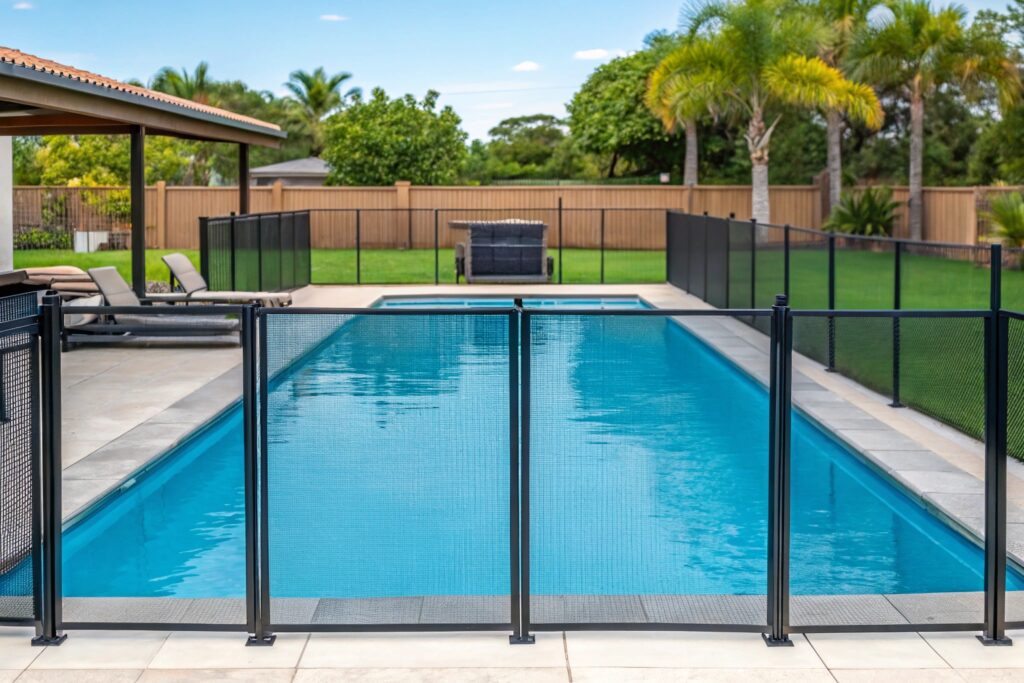
The table in the previous section covers the minimum standards. But knowing the numbers and understanding how they apply to a real backyard are two different things. Most compliance failures aren’t from people ignoring the rules — they’re from people who didn’t realise the rules applied to something they’d had in place for years.
Non-climbable zones are the biggest source of failures. The 900mm arc from the top of the fence must be completely clear. A pot plant moved against the fence for summer, a garden bed that’s grown up over time, outdoor furniture left too close — all of it counts.
Gate mechanics are the second most common issue. Gates must be self-closing and self-latching, with the latch on the pool side. A gate that swings toward the pool, or a latch that sticks or fails, is an automatic fail.
Boundary fences used as pool barriers need to meet a higher standard — 1.8m rather than 1.2m — and must have no climbable features on the outside face within the NCZ.
Sloped blocks add another layer of complexity. On uneven ground, fence height is measured from the finished ground level on the outside of the barrier, which can catch homeowners off guard if the ground has been landscaped since installation.
💡 Tip: Walk your pool fence line before any inspection. Check for anything within 900mm of the fence — furniture, plants, equipment, or stored items. It’s the easiest fix and the most commonly missed.
The Approval Process — Timeline and Documentation
Building a pool in the Singleton Council area without the right approvals isn’t just risky — it’s illegal. Here’s how the process works from start to finish.
- Lodge a Development Application (DA) with Singleton Council, including site plans, pool specifications, barrier details, and a BASIX certificate.
- Wait for DA assessment. Singleton Council typically assesses pool DAs within 40 days.
- Receive Development Consent. Once approved, construction can begin in accordance with the approved plans.
- Book mandatory inspections. Required at set stages during construction — missing one means work stops.
- Obtain a Construction Certificate (CC) or Complying Development Certificate (CDC) before work starts.
- Final inspection and Occupation Certificate (OC) confirms the pool is compliant and safe for use.
- Register on the NSW Swimming Pool Register before a Certificate of Compliance can be issued.
Common Compliance Issues and How to Avoid Them
Most pool compliance failures in the Singleton area come down to the same handful of issues. Knowing what they are puts you ahead of most homeowners.
- NCZ violations — furniture, plants, or equipment placed within 900mm of the fence line. See the barrier requirements section for the full rundown.
- Gate failures — latches that don’t self-close, gates that swing toward the pool, or hardware that’s corroded and no longer functions correctly.
- Sloped block fence heights — on uneven ground, fence height is measured from the outside ground level, which can mean sections of an existing fence fall short without the owner realising.
- Lapsed registration — pools must remain registered on the NSW Swimming Pool Register at all times. Registration isn’t a one-off step.
- Outdated barriers on older pools — pre-1990 pools are frequently inspected against current standards and found non-compliant, particularly around gate hardware and NCZ clearances.
⚠️ Note: If you’re buying a property with an existing pool, request a current Certificate of Compliance before settlement. An inherited non-compliant pool becomes your legal responsibility the moment you take ownership.
Pool Certificate of Compliance — What Singleton Homeowners Need to Know
A Certificate of Compliance isn’t just a piece of paper. It’s legal proof that your pool meets current NSW safety standards — and without one, you can’t legally sell or lease a property with a pool in NSW.
When It’s Legally Required
A Certificate of Compliance is required when selling or leasing a property with a pool or spa. It must be attached to the contract of sale or tenancy agreement. Certificates are valid for three years for properties being sold, and one year for leased properties.
How to Book a Singleton Council Inspection
Inspections can be booked directly through Singleton Council or through a council-accredited private certifier. You’ll need to have your pool registered on the NSW Swimming Pool Register before booking. Have your registration number ready when you call.
What Happens If You Fail
A failed inspection results in a non-compliance notice outlining what needs to be rectified. You’ll have a set timeframe to make the required changes and rebook. Repeated failures or failure to act on a notice can escalate to formal penalty notices and fines of up to $5,500.
💡 Tip: Book your inspection well ahead of any planned sale or lease. Rectification work takes time, and settlement deadlines don’t move easily.
Working With a Licensed Pool Builder in Singleton
Singleton Council pool compliance regulations aren’t something you want to work out as you go. A licensed pool builder who knows the local area takes the guesswork out of the process — from DA lodgement through to your final inspection.
NSW Fair Trading requires all pool builders to hold a current contractor licence. Before signing anything, check your builder’s licence number on the NSW Fair Trading licence register. It takes two minutes and tells you whether they’re licensed for the work, whether any complaints have been lodged, and whether their licence is current.
A builder with Singleton experience will already know the common sticking points — sloped blocks in areas like Cessnock Road surrounds, older properties in the Singleton town centre with boundary fence complications, and council’s typical turnaround on DA assessments in the Hunter Region.
Beyond licensing, ask your builder how they handle mandatory inspection stages, who manages council communication during the build, and whether they assist with NSW Swimming Pool Register setup. These aren’t extras — they’re part of a compliant build.
Working with the right builder means your pool certificate of compliance in NSW is handled correctly from day one, not chased up after the fact.
Ready to Build a Compliant Pool in Singleton?
Getting your pool approved and certified in the Singleton Council area doesn’t have to be complicated. With the right builder handling the process, you can go from DA lodgement to Certificate of Compliance without the stress of chasing paperwork or failing inspections.
Pool Builders Newcastle works with homeowners across the Singleton and Hunter Region to design and build pools that meet current NSW safety standards from the ground up. We handle council communication, mandatory inspection stages, and NSW Swimming Pool Register setup as part of every build.
Get a free compliance consultation today and find out exactly what’s involved for your property.
📞 Call us on 0240036418

